

A brief note before we resume: if you haven’t already, do check out Films Not Made - the podcast I co-host with Amy Hobby about the ones that got away. The ones that almost existed. The phantom limbs of cinema. New episodes dropping regularly (Yesterday! Oppenheimer!), and the conversations continue to delight me in ways that the actual films, had they been made, probably would have as well.
And oh yeah… AI!
Now then. Nashville. Actual real-life filmmaking!
We last left the production in the glow of Castle Kane — an estate whose architecture suggested that generational wealth had briefly consulted with a theme park designer before losing interest midway through. Basketball with Luke Bryan. Virtual golf. A tour bus interview conducted, for insurance reasons, at zero miles per hour. The production had promised a down day, which arrived with the bureaucratic punctuality of a government holiday, and then we were back - the machinery of observation resuming its slow, deliberate choreography.
(Spoiler Alert! The food, for those tracking the culinary subplot of this series, did not improve. It pivoted. From Southern excess to Mediterranean adjacency. The distinction, as you’ll discover, is largely semantic.)
Project: It’s All Country
March 1, 2024
It’s all the same
The morning draped Nashville in a shroud of gray, the rain a persistent companion as Michelle, Athena, Kyle, and I navigated the philosophical minefield of documentary cinema within the cramped confines of our vehicle. As we dissected the anatomy of storytelling, the car veered towards “Mulberry Downs,” a name that conjured memories of Brooklyn’s mulberry-stained sidewalks and invoked images of thoroughbreds thundering down the track. Yet, this “Downs” was no racetrack but a sprawling labyrinth of cookie-cutter townhouses, a testament to the vinyl and aluminum gods of suburbia.
Michelle likened the scene to “The Truman Show,” a comparison as apt as it was unsettling, casting us as unwitting extras in a scripted reality. I countered with “a compressed Levittown,” a nod to the post-war American dream packaged in neat, identical parcels. Tomato, tomahto — the essence remained the same; we were adrift in a sea of architectural sameness, a dystopian suburbia where uniqueness went to die.
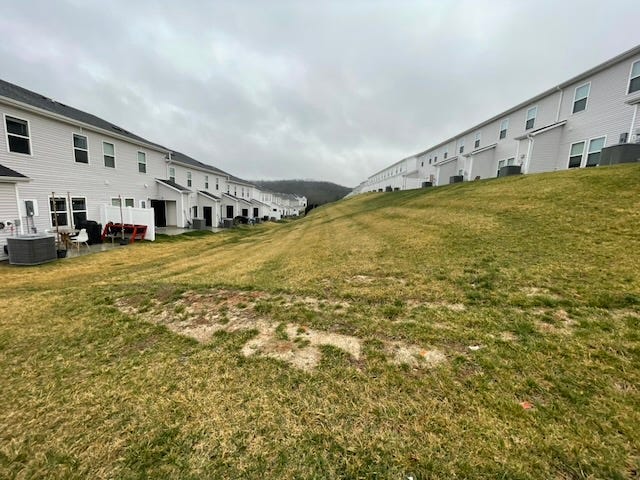
Our destination, it turned out, was the abode of Tenille Arts, a domicile so fresh it practically sparkled with the scent of paint and the heady aroma of new furniture’s off-gassing bouquet. The cardboard box sentinels standing guard outside were the only hint of the recent invasion of moving vans. Inside, the air was as crisp and untainted as the unblemished walls, a blank canvas upon which Tenille’s life in Nashville was just beginning to paint its first strokes.
Our venture into the creative sanctum of Tenille Arts unfolded like a nocturnal ballet, the camera lens capturing the quiet magic of her midnight musings. The witching hour, 3:33 AM, held a sacred resonance, a shared secret between Tenille and Michelle, both attuned to the ethereal “angel times” that punctuated their days with whispers of inspiration. In the sanctity of her music room, Tenille’s Paul Reed Smith guitars stood sentinel, each a sparkling testament to her craft, their names a chorus of birds, a harmony of wood and wire.
The concept of a “Pity Party” was Tenille’s artistic exorcism, a rite of passage through which emotions were felt, acknowledged, and then set free, the residue of heartache fueling the next creation. Perhaps it was in this crucible of creativity that “Call Me When You Get Home Friends” was forged, a melody so hauntingly familiar it wove itself into the fabric of the day, an earworm accompanying the crew from shot to shot.
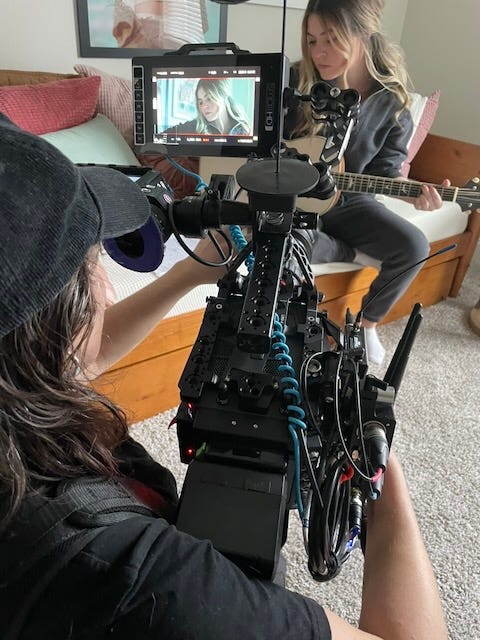
The expedition continued into the wardrobe, a treasure trove where denim rubbed shoulders with Dolce & Gabbana, and boots, an army of them, stood at the ready for any occasion. The pièce de résistance, a miniature doppelgänger of her red carpet attire, whispered tales of glamour and spotlights. For today’s collaboration with Alex Kline, the sartorial choice was unapologetically Canadian — a denim-on-denim ensemble that spoke of comfort, confidence, and a touch of whimsy.
Downstairs, the interview took a turn towards the introspective, tracing the melodic contours of Tenille’s life back to its genesis. As a child, lost in the throes of a Shania Twain anthem, her voice carried beyond the confines of her backyard to the ears of a neighbor, marking the inception of her journey into the limelight. The female powerhouses of the ’90s, with their tales of heartache and triumph, became the celestial bodies around which Tenille’s musical universe orbited. The landscape of music, she mused, had shifted towards the raw and real, where the polish of perfection gave way to the grit of genuine storytelling, a realm where the scars of life were badges of honor, not blemishes to be airbrushed away.
Meanwhile, in this era of social media, the veil between artist and audience has thinned, offering a window into the unvarnished realities of the person behind the persona. Tenille, standing firm in her authenticity, eschewed the siren call of cosmetic conformity, her roots as a “farm girl” grounding her in a sense of self that no scalpel could sculpt. At the zenith of her pantheon stood Taylor Swift, the lodestar whose path of relentless reinvention and raw honesty lit the way for Tenille’s own odyssey.
The revelation that her collaboration with an all-female team was a pioneering first was a moment of serendipitous discovery, underscoring the groundbreaking nature of her journey. “Somebody Like That” scaling the charts to claim the number one spot was a milestone, yet it begot the daunting question of “Now what?” But in the faces of her “little army” of fans, Tenille saw not just fans but comrades-in-arms in the relentless pursuit of authenticity.
To Tenille, country music is not just a genre but a sanctuary, a narrative tapestry where stories of the human condition find voice and solace. As she stands on the cusp of unveiling a new album, anticipation shimmered in the air…
And then, lunch.
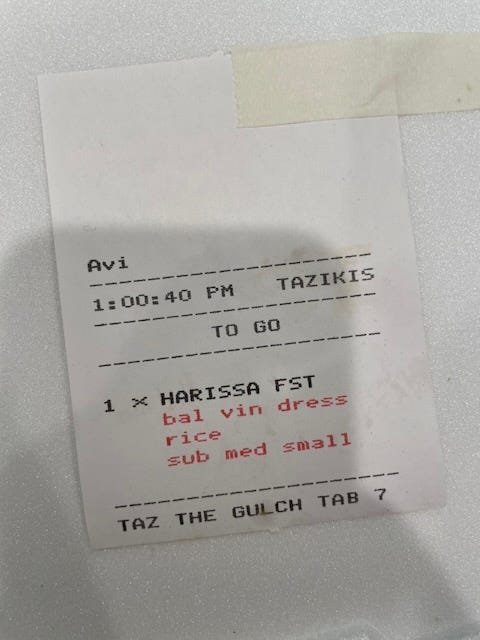
Lunch with the crew unfolded as a culinary odyssey into the nebulous realm of “Taziki’s,” a dining establishment that seemed to have sprung up from the fertile imaginations of those who view the Mediterranean through the lens of a fast-casual fever dream. The name itself, a bastardization of the venerable tzatziki sauce, felt like a slight to the rich tapestry of Turkish and Greek cuisine, reducing a culinary tradition to a mere condiment with a missing letter. Was this an act of culinary audacity or just a branding faux pas?
Our veteran ensemble seemed oddly enchanted by the offerings of this gastronomic chimera. Jiy waxed poetic about a piece of salmon that seemed to have been petrified rather than cooked, its sheen suggesting a polyurethane finish rather than a culinary one. Craig, on the other hand, navigated his lamb burger with the ease of a man who had found an unexpected oasis in the desert of our lunch options. Tempted as I was to follow suit, a moment of reckless abandon saw me opting for the “Mediterranean” salad, crowned with what was promised as “spicy harissa chicken.”
The chicken, an enigma wrapped in a riddle and buried under the library of Ephesus, managed to be simultaneously moist and as tough as a leather-bound volume of Homer’s “Iliad,” sans the spice that harissa traditionally promises. The notion that this chicken had ever made the acquaintance of harissa seemed as fanciful as the restaurant’s grasp on its namesake sauce. Jake’s surreptitious addition of salt to his meal stood as a silent testament to the seasoning shortfall, an unspoken critique in a sea of misplaced culinary enthusiasm.
As for my salad, it was Mediterranean in the same way that a postcard from the gift shop under the nearby replica of the Parthenon is Greek architecture — adjacent, perhaps, but hardly a substitute for the real thing. The roasted red peppers and the cursory sprinkle of feta cheese could no more transport me to the Aegean than the meal’s clamshell container could double as a trireme. Yet, as Socrates said — “hunger is the best relish,” and so I soldiered on, navigating the mildly treacherous waters of this “Mediterranean” mirage, my taste buds yearning for the shores of authenticity, even as we set sail on the SS Taziki’s, bound for parts unknown.
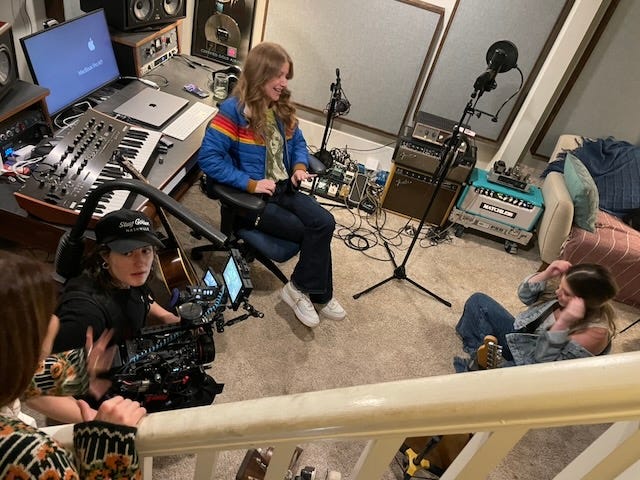
The day’s odyssey culminated in the subterranean sanctuary of Alex’s basement studio, a hallowed ground where sonic alchemy and sisterhood intertwined to birth chart-topping magic. Amidst the warm glow of ambient lights and the comforting embrace of familiar walls, Alex and Tenille recalled the ritual that had once conjured their number one hit into the realm of reality. It was more than a studio session; it was a reunion of muses, a testament to the power of their creative synergy.
The playback of their new song was a moment of revelation, the notes dancing in the air like sparks, each one a testament to their journey from dream to anthem. Amidst the reverie of music, Alex unveiled a treasure, a 1955 Gibson acoustic guitar, its wood seasoned with the whispers of bygone eras, a new guardian of their musical legacy. The instrument was not merely a tool but a talisman, imbued with the essence of every note it had ever cradled.
Tenille found solace on the floor, a serene moment shared with Patsy Cline, Alex’s canine companion and the most musically literate dog this side of Nashville, her vaccinations as up-to-date as the charts they aspired to conquer. In that moment, the studio transcended its physical confines, becoming a haven where the sisterhood of songwriters could bask in the comfort of unspoken understandings and shared aspirations.
Insiders tomorrow at Music City!
PARTING SHOT
Are you sick of hearing about AI yet?
As I write this, SAG-AFTRA has paused negotiations with the studios - no deal, talks resume in June - and the WGA just sat down at the same table, contracts expiring, AI protections at the top of both agendas. The guilds want compensation when existing performances and scripts are used to train the models. They should get it. But as I argue in a forthcoming essay on art in the age of AI reproduction, the question was never really about the technology. Your talent still matters - it just isn’t sufficient anymore, not in a world that reorganizes itself faster than you can update your résumé. What’s sufficient is the willingness to improvise: to put your work out there on your own terms, to embrace tools that make you uncomfortable, to stay in the room when the room keeps changing shape around you.
Compute is disappearing. The distance between the artist and the audience is collapsing. AI is becoming the connective tissue - not the replacement, the connector. The guardrails will come. The contracts will get signed. But the artists who thrive through this will be the ones who didn’t wait for permission. More on that soon.